By: Danielle Powell
Name, Image, and Likeness (NIL) monetization has given female student-athletes new financial opportunities, but it has also exposed them to new dangers.[1] As women’s college sports draw larger audiences and record engagement levels, athletes’ public profiles have grown, and NIL platforms seek to expand them further.[2] That visibility raises athletes’ brand value, but it also makes them targets for harassment, including sexual harassment, stalking, and physical threats.[3] The NCAA’s current response, which includes education and awareness campaigns, is inadequate in protecting student-athletes, particularly women, and requires institutional safeguards that match the scale of the risk.
The scale of threat is difficult to measure. The FBI says that it fields “more than 3,000 tips a day about victims of cyber sexual exploitation,” and although the agency cannot quantify the number of college athlete victims, officials believe that “the combination of social media exposure and NIL funding make college athletes especially vulnerable.”[4] Athletes are entering this environment with a risk women already face; surveys estimate that between 16% and 58% of women and girls worldwide have experienced online violence.[5] Women already face disproportionate online violence, and NIL’s demand for larger public followings intensifies that existing risk.
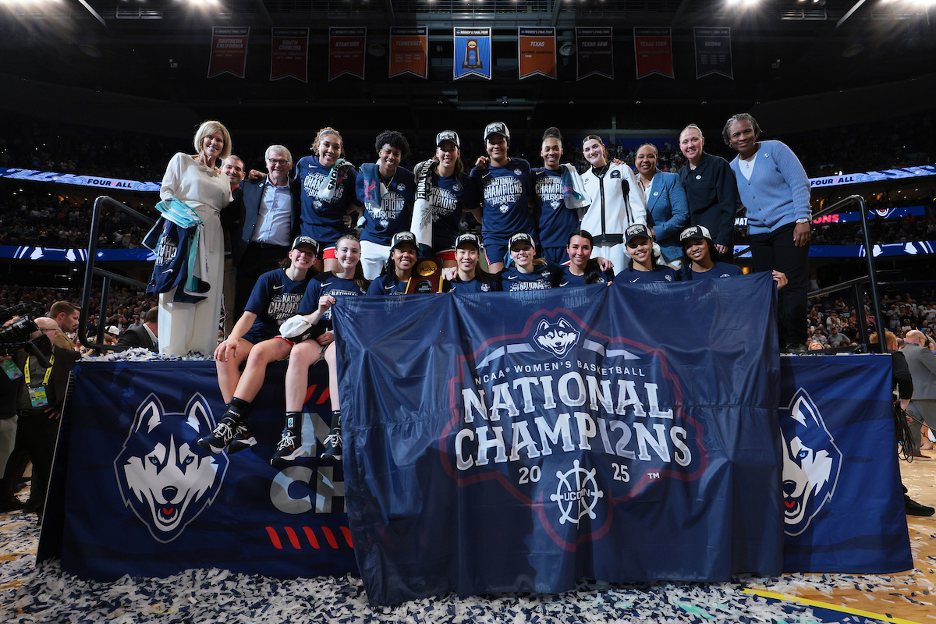
Former University of Connecticut star Paige Bueckers shows how NIL opportunities can rapidly elevate a college athlete’s profile, while also bringing increased exposure and potential risks. As NIL opportunities expanded, Bueckers quickly became one of their most visible beneficiaries, signing major endorsement deals and rapidly increasing her visibility.[6] This resulted in her facing incidents of disruptions, harassment, and stalking. Specifically in December of 2024, an Oregon man pled guilty to second-degree stalking Bueckers through various social media accounts.[7] In response, UConn has discussed increasing their security detail for the team,[8] demonstrating that even a high-profile athlete at a well-funded program can become an online target overnight.
Online threats often go beyond harassment. The FBI defines sextortion as “cyber-enabled tactics sexual exploitation actors use to obtain and sell [the victim’s] private images.”[9] Although anyone can be targeted, student-athletes have become a major target for predators. The FBI has concluded that their visibility, “expanded through [NIL] activity, and their visible standing within their schools and communities,” along with the “leverage offenders believe they hold when threatening exposure,” makes them frequent targets.[10] This burden does not fall equally as scholarship finds that sextortion disproportionately impacts women, and that these abuses perpetuate harmful societal norms.[11] Thereby, the greatest risks to athletes’ safety now live in their digital lives.
Title IX turns this cybersecurity problem into a question of institutional responsibility. The statute prohibits sex-based discrimination in federally funded education programs.[12] A university may be liable for damages when an appropriate official has actual knowledge of severe, pervasive, and objectively offensive sexual harassment and the institution responds with deliberate indifference.[13] That standard, however, generally requires substantial institutional control over both the harasser and the context of the misconduct.[14] Because NIL-related abuse often comes from unaffiliated online actors, universities will rarely face liability for it. But the absence of liability does not mean absence of responsibility. Therefore, colleges should adopt cybersecurity assistance, confidential reporting systems, and security protocols before harassment deprives athletes of equal access to their education or sport.
The NCAA and the FBI have announced a joint initiative to educate student-athletes about the tactics used to obtain and sell their images and to give them resources for reporting these crimes.[15] Education matters, but it puts the burden on the people being targeted. Professional athletes have “private security teams and digital risk consultants,” while “most collegiate athletic programs lack even basic travel privacy protocols or cybersecurity safeguards.”[16] Closing that gap would require institutions to act, for example by providing cybersecurity support for athletes’ accounts and devices, and specific travel and event security protocols. Without such changes, education alone leaves college athletes, disproportionately female, to “bear the burden of a system that monetizes their visibility while failing to adequately safeguard their wellbeing.”[17]
[1] Amelia Taylor, The Cost of Visibility: How NIL & Prop Betting Are Exposing College Athletes to Growing Safety Threats, Sports L. Ass’n Blog, https://blog.sportslaw.org/ [https://perma.cc/A4JL-9BJ8].
[2] Id.
[3] Id.
[4] Dana O’Neil, NCAA and FBI to partner up to help athletes avoid being sexually exploited online, CNN Sports (Aug. 10, 2026), https://www.cnn.com/ [https://perma.cc/8GEU-SU2T].
[5] Jacqueline Hicks, K4D Helpdesk, Global Evidence on the Prevalence and Impact of Online Gender-based Violence (OGBV) 2 (Inst. of Dev. Stud. 2021).
[6] Sasha Rogelberg, From borrowing her mom’s credit card to a $1.5 million net worth, WNBA star Paige Bueckers wasn’t prepared for ‘super fast’ NIL financial jump, Fortune (Sep. 9, 2025, at 13:00 ET), https://fortune.com/ [https://perma.cc/E6JL-ZBFF].
[7] Associated Press, Man pleads guilty to stalking UConn basketball star Paige Bueckers, Courthouse News Serv. (Dec. 18, 2024), https://www.courthousenews.com/ [https://perma.cc/U4X4-VE5P].
[8] Paul Steinbach, UConn Considers Safety Measures in Wake of Paige Bueckers Stalker’s Arrest, Athletic Business (Sep. 20, 2024), https://www.athleticbusiness.com/ [https://perma.cc/TW7N-SKMT].
[9] Press Release, Fed. Bureau of Inv., FBI and Partners Warn Student-Athletes of Sexual Exploitation Schemes (Aug. 10, 2026) https://www.fbi.gov/ [https://perma.cc/V6MQ-PMYU].
[10] Id.
[11] Whitney Bragagnolo & Yaneí Lezama, Unveiling sextortion in sport: a global inquiry into the nexus of sexual violence, abuse of power, and corruption for enhanced safeguarding, 83 Crime, L., and Soc. Change 1, 2 (2025).
[12] 20 USCS § 1681(a).
[13] Davis v. Monroe Cnty Bd. of Educ., 526 U.S. 629, 633 (1999).
[14] Id. at 645-46.
[15] Fed. Bureau of Inv., supra note 9.
[16] Taylor, supra note 1.
[17] Id.